The Gig Money Kit
The GigBand method for a gig's money: the deal read as a door net, the costs agreed before the show, the merch table's real profit, and a split that adds up to the pot to the cent
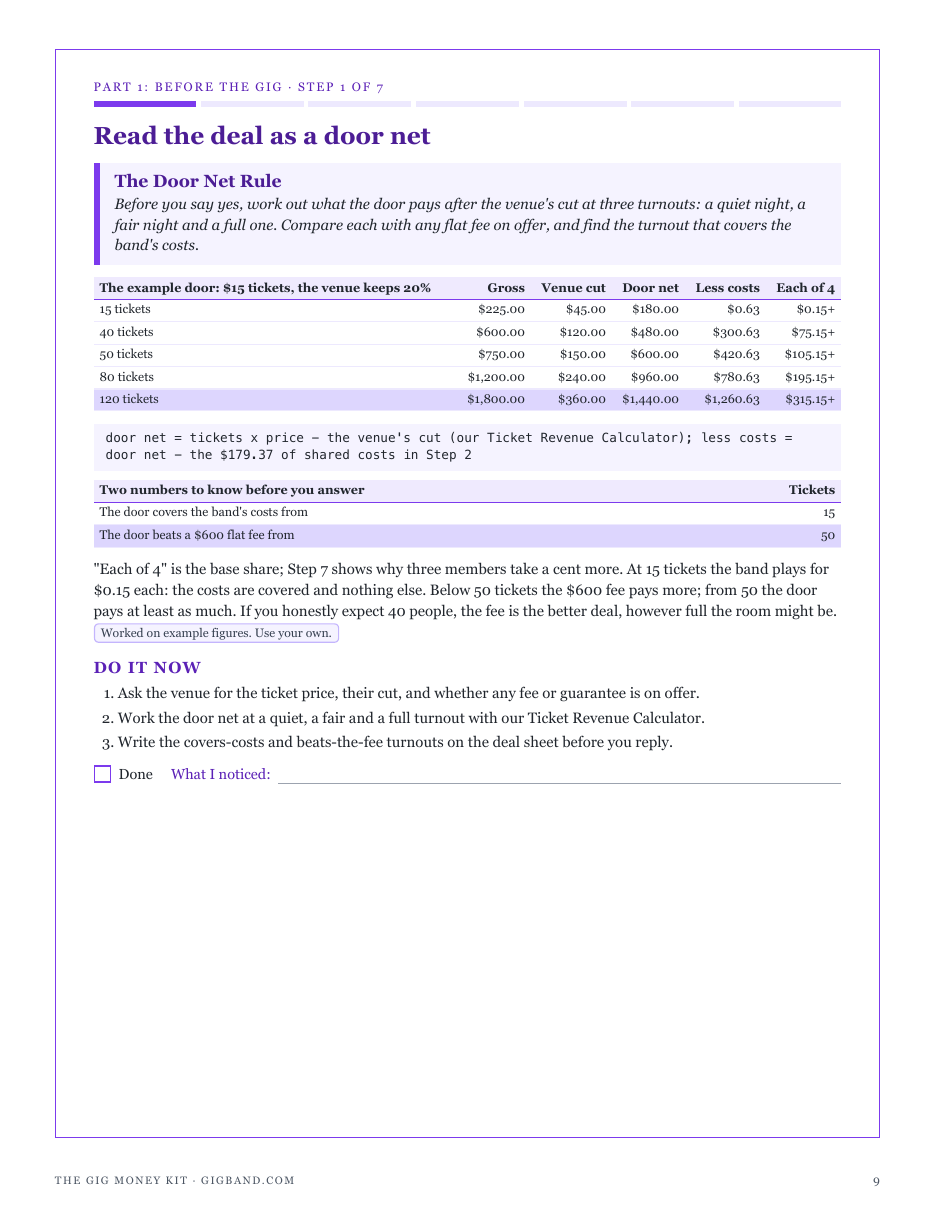
GigBand's free Ticket Revenue Calculator stops at the door's net. The Merch Profit Calculator works out profit on the shirts you sold, before card fees, the venue's merch cut and the stock still in the box, as its own page says. The Gig Pay Split Calculator asks for one total that neither of the others hands it. Settling a gig asks all three at once, at the end of a long night, with the whole band watching. The kit carries the night from the offer to each member's share. On the worked example, a four-piece sells 30 shirts at $25 from an order of 60 at $8: the merch calculator says $510 profit, and after card fees, a 20% venue cut and the 30 shirts in the box the order has made $103.20. The door nets $1,440, the agreed costs are $179.37, the stock is repaid first, and the $1,363.83 pot is split in whole cents: three members take $340.96 and one takes $340.95, where rounding each share on its own would pay out $1,363.84. Every figure is computed by the site's own calculators; the turnout, prices, cuts, card rate and print prices are examples, and the rules of thumb are called rules of thumb. It is organization and arithmetic, not tax or legal advice: taxes on gig income, sales tax on merch and band agreements vary by place, so check locally or with an accountant. Inside: seven steps, a deal sheet, a merch count sheet, a settlement sheet, a season ledger, reference tables, a quickstart and a hearing protection line, plus a personalised sheet worked from the numbers you enter in our calculators.
Look inside
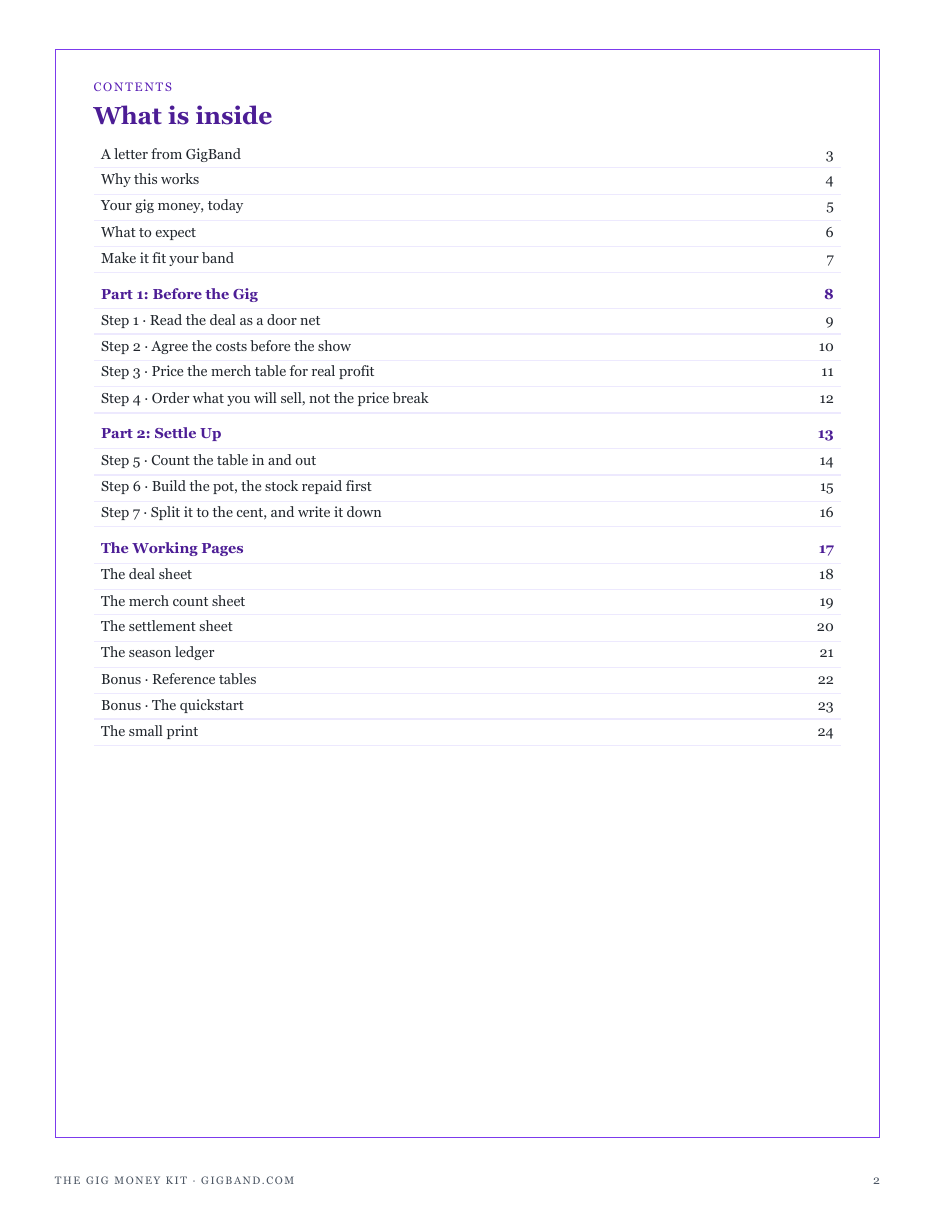
Two full pages from the kit, exactly as printed. Click either to read it at full size before you decide.
What is in it
- The Door Net Rule: the deal read as the door's net at three turnouts, the turnout that covers the band's costs, and the one that beats a flat fee
- The Off the Top Rule: the shared costs agreed before the show, with receipts, and what stays personal
- The Real Profit Rule: merch profit after card fees, the venue's merch cut and the shirts still in the box
- The Price Break Rule: a merch order sized to what you will sell, not to the printer's cheapest price per shirt
- The Count Rule: the merch table counted in and out, with cash plus card reconciled to shirts sold
- The Stock First Rule: the pot built with the merch order and the agreed costs repaid first
- The Exact Split Rule: the pot split in whole cents, the odd cents taken by turn, every member initialing the sheet
- Printable working pages: a deal sheet, a merch count sheet, a settlement sheet and a season ledger
- Reference tables: what one shirt leaves you by price and venue cut, and shirts to sell to repay an order, plus a quickstart
- A personalised sheet worked from the numbers you enter in our calculators
- ✓ 24 printable pages
- ✓ 10 sections, worksheets and templates
- ✓ A second PDF worked out from the numbers you enter
- ✓ No account needed, just an email address
- ✓ Instant download; link valid 7 days
Price includes any taxes. Sold by GrabURL, who handle checkout and support. The charge appears on your statement as GrabURL.
The kit picks up where the free Gig Pay Split Calculator leaves off. The split needs one total, and nothing on the site hands it one: the Ticket Revenue Calculatorstops at the door's net, and the Merch Profit Calculatorcounts profit on the shirts you sold before card fees, the venue's merch cut and the stock still in the box. The kit reads the deal as a door net at three turnouts, agrees the shared costs before the show, prices the merch table after everything it leaves out, sizes the next order to what you really sell, counts the table in and out, repays the stock first and splits the pot in whole cents so the shares add up exactly. It is organization and arithmetic, not tax or legal advice: taxes on gig income, sales tax on merch and band agreements vary by place, so check locally or with an accountant. Wear hearing protection at soundcheck, the show and rehearsal. The worked figures are examples, and the card rate and venue cuts are yours to fill in.